In Conversation With: StoryKeep on the Power of Story in Preserving Family Legacy
Posted by Bedrock on
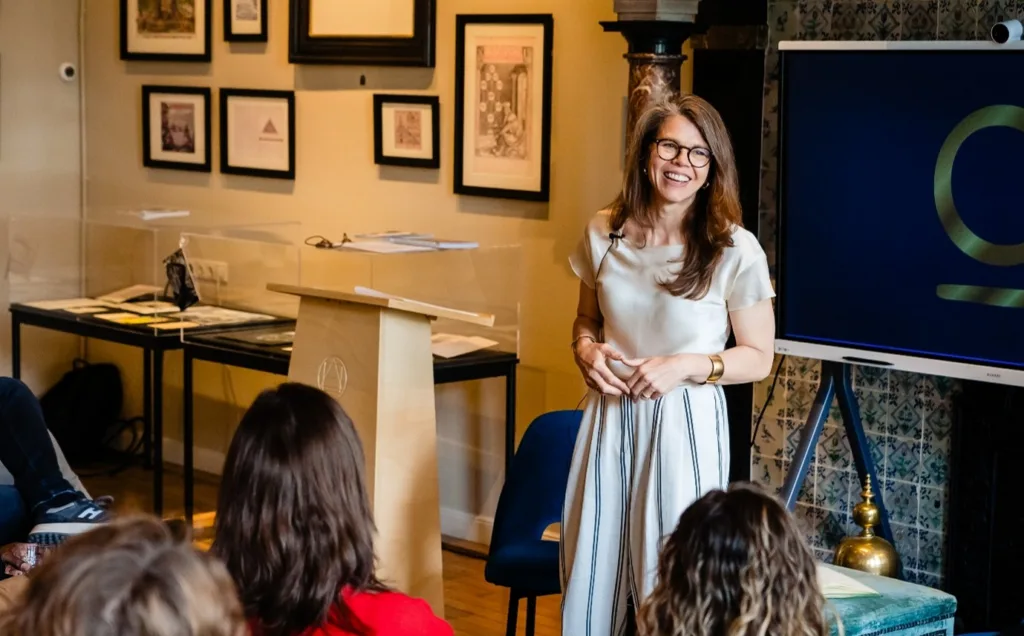
Founder, Jamie Hurkmans-Yuenger speaking to families at the StoryKeep Annual Symposium
When conversations around legacy take place, the focus often centres on wealth: how it is protected, transferred and stewarded across generations. Yet some of the most important elements of a family’s legacy cannot be measured financially. They live in the experiences, values, relationships, and stories that help family members understand who they are, and why that matters.
In this edition of our In Conversation With series, we spoke with Jamie Hurkmans-Yuenger, Founder and CEO of StoryKeep – a storytelling and legacy-preservation company that helps families capture, preserve and share their histories, values and experiences through bespoke films, podcasts and other legacy media.
Jamie shares her perspective on why more families are beginning to think about narrative as an essential part of continuity, and what she’s learned after sixteen years of documenting the lives of enterprising families around the world.
A Different Kind of Legacy Work
Q: What inspired you to found StoryKeep, and what does the company do today?
I’ve always been fascinated by how people become who they are.
Even as a child, I was endlessly curious. Why did this person become a teacher? How did someone end up leading a business? What experiences shaped their character? That curiosity eventually led me to study psychology, then folklore, which, despite the name, is really the study of how culture is transmitted over time, and later documentary storytelling and broadcast journalism.
I was working as a radio reporter in New York when a friend asked if I would interview and document her father-in-law’s life. I accepted almost on a whim.
During that interview, I had what I still think of as a lightning-bolt moment.
I realised that all of my professional training had been devoted to helping strangers understand public figures. Yet here was an equally powerful application: helping families understand themselves.
What struck me wasn’t simply that they wanted to preserve his memories. They wanted future generations to understand their grandfather, and through him, better understand themselves.
That project became StoryKeep.
Today we work with enterprising families around the world, creating privately commissioned documentary films and virtual story museums that preserve family history, business history, values, and lived experience. Over the years, however, I’ve come to realise that the films themselves aren’t really the point.
They’re a way of helping families better understand who they are, what has shaped them, and what they hope to carry forward.
Preserving What Matters Most
Q: What are families really hoping to achieve when they begin this kind of project?
Most families come to us believing they’re preserving a story.
What they’re often preserving is something much deeper.
A family might say, “We want to document Mom and Dad before it’s too late,” or “We want to capture Grandpa’s story.” Those are genuine goals, but they’re often just the tip of the iceberg.
Underneath, something else is usually happening.
A leadership transition may be underway. The family may be growing, becoming more geographically dispersed, or welcoming a new generation of children. People begin asking bigger questions: Who are we? What do we hope continues? What do we want future generations to understand about this family?
That’s why I often see that the process of creating the film is every bit as valuable as the film itself. I’m incredibly proud of the films we make, but the conversations leading up to them are often where the real transformation happens.
Families discover they’re not simply trying to preserve memories. They’re trying to preserve the context that gives those memories meaning.
They want future generations to understand not only what happened, but why it mattered.
“The process of creating the film is often every bit as valuable as the film itself.”
Giving Wealth Meaning
Q: Why is preserving a family’s story just as important as preserving financial wealth?
Families often spend decades preparing the next generation to inherit wealth. Far fewer spend the same energy helping them inherit meaning.
Stories provide the context that financial statements never can. They reveal the setbacks, the sacrifices, the moments of resilience, the relationships, and the decisions that shaped not only the family’s success, but its identity.
I’ve noticed that many founders are becoming more willing to talk about hardship than they were even a decade ago. They don’t want their children or grandchildren to believe success was inevitable. They want them to understand how easily things could have turned out differently, and what helped them persevere.
Without that context, wealth can become disconnected from the values that created it. Stories reconnect wealth with meaning.
“Without that context, wealth can become disconnected from the values that created it. Stories reconnect wealth with meaning.”
Making Space for Every Perspective
Q: How do you help families uncover those stories?
Every project begins with discovery, and that phase usually lasts six to eight weeks.
People often imagine that we arrive with cameras and begin interviewing. In reality, we spend weeks listening first.
We’re trying to understand where the family is today, what transition they may be experiencing, what they hope this project will accomplish, and what stories have quietly shaped who they are.
One of the most valuable things about being an independent third party is that we can create space for voices that aren’t always heard. Every family has people who naturally speak more than others. Our role is to make sure different generations and different perspectives become part of the conversation.
By the end of discovery, families often tell us they see themselves differently than they did when we started.
That’s one of my favorite moments.
Unearthing the Stories That Shape Us
Q: What surprises families most during the process?
One of the biggest surprises is realising that the stories they almost left out often become the most important ones.
I remember working with a family that wanted to document their father and uncle. During discovery, they briefly mentioned a painful experience from childhood and immediately dismissed it as probably not being relevant.
As we gently explored it together, it became clear that this single experience had shaped how they led, how they approached adversity, and where much of their resilience had come from. It ultimately became one of the central threads of the film.
That happens far more often than people might imagine.
We’re not always the best judges of which moments in our own lives were most significant.
By the end of the process, families often leave saying, “I had no idea our history was this rich.”
More importantly, they leave with greater clarity about where they’re going next. The work isn’t about nostalgia. It’s about using the past to move forward with greater intention.
“The work isn’t about nostalgia. It’s about using the past to move forward with greater intention.”
Legacy as an Ongoing Conversation
Q: How do families move from preserving a legacy to actively stewarding it?
Increasingly, families see this work not as a one-time project but as an ongoing practice.
A family’s story doesn’t stop evolving simply because a film has been completed.
That’s one of the reasons we created our Virtual Story Museums. They give families a place to continue adding new voices, new chapters, and new perspectives over time.
A founder’s story may be where the journey begins. Later, that family may decide to document a daughter whose greatest contribution has been philanthropy, or grandchildren beginning to define leadership in their own generation.
Legacy isn’t something you finish. It’s something you continually steward.
The Lasting Impact of Creating Family Stories
Q: Finally, after sixteen years of doing this work, how has it changed you?
What a fantastic question. Thank you for asking. It’s changed me profoundly.
I’ve borrowed something from every family we’ve worked with. Sometimes it’s something very simple, like creating more intentional family traditions, or taking the time to celebrate milestones that otherwise might pass by unnoticed.
Professionally, it’s shaped the kind of company we’re trying to build.
I began as a freelance creative, and I know how difficult that life can be. One of my greatest hopes is that StoryKeep becomes a place where talented filmmakers, producers, and storytellers can do deeply meaningful work, be respected for their craft, and know they’ve made a genuine difference in people’s lives.
What moves me most, though, is seeing the impact on families themselves. I’ve watched people begin speaking again after years of distance. I’ve seen relationships soften. I’ve watched stories create understanding where big assumptions once existed.
When you realise that the work you’re doing today may strengthen a family’s relationships for generations to come, it’s hard not to feel incredibly grateful.
Because ultimately, that’s what legacy is. It’s not simply what we leave behind. It’s what continues to shape the people we love long after we’re gone.
“When you realise that the work you’re doing today may strengthen a family’s relationships for generations to come, it’s hard not to feel incredibly grateful.”
To learn more about StoryKeep and their work with enterprising families, please visit www.storykeep.com.
If you would like to learn more about Bedrock’s approach to supporting multigenerational families, from defining shared purpose and articulating family values to establishing effective frameworks for communication, governance and family engagement, please feel free to contact us at info@bedrockgroup.com.
Important Legal Information
The information and opinions contained in this article are for background information and discussion purposes only and do not purport to be full or complete. No information in this document should be construed as providing financial, investment or other professional advice. The views and opinions expressed herein are based on current market conditions and are subject to change without notice. No representation is made that any forecast or projection will be realised. Information included in this document is intended for those investors who meet the definition of Professional Client under the Swiss FinSA regulation as well as Professional Client or Eligible Counterparty under the UK Financial Conduct Authority.
Investment Risks The value of all investments and the income derived therefrom can fluctuate due to market movements and you may not get back the amount originally invested.
Limitation of Liability and Indemnity Bedrock expressly disclaims liability for errors or omissions in the information and data contained in this document. No representation or warranty of any kind, implied, expressed or statutory, is given in conjunction with the information and data. Bedrock accepts no liability for any loss or damage arising out of the use or misuse of or reliance on the information provided including, without limitation, any loss of profits or any other damage, direct or consequential. You agree to indemnify and hold harm less Bedrock and its affiliates, and the directors and employees of Bedrock and its affiliates from and against any and all liabilities, claims, damages, losses or expenses, including legal fees and expenses arising out of your access to or use of the information in this presentation, save to the extent that such losses may not be excluded pursuant to applicable law or regulation. Any opinions contained in this presentation may be changed after issue at any time without notice.
Copyright and Other Rights The copyright, trademarks and all similar rights of this presentation and the contents, including all information, graphics, code, text and design, are owned by Bedrock.
Governance is often defined by the structures, processes and decisions that help families preserve wealth, navigate complexity and maintain continuity across generations. However, governance is not only expressed through formal frameworks relating to wealth and family business operations. It also exists in the people and systems that support daily family life. As family life has […]
In our latest Inheriting the Future essay, Bedrock Advisory Board member, Kydd Boyle, explores four lessons from some of Europe's most enduring family businesses on innovation, identity and thriving across generations.
Bedrock Advisory Board member, Kydd Boyle, explores the growing gap between rising inherited wealth and philanthropic giving, arguing that younger generations often delay meaningful action despite caring deeply about impact. He suggests the greatest social impact comes from starting early and allowing philanthropy to compound over time.